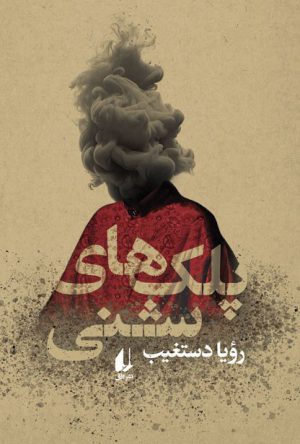
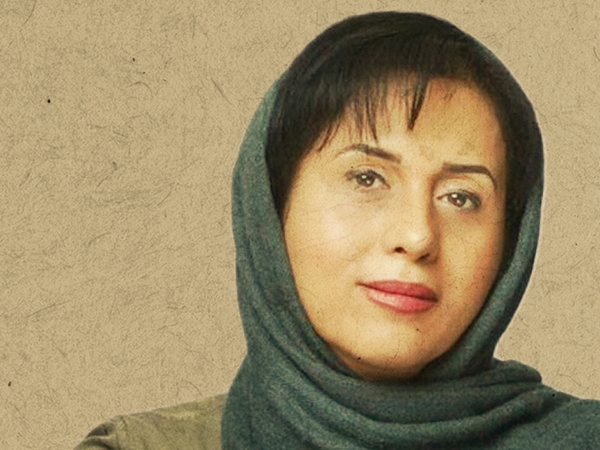
The passion for reading and writing freely led Roya Dastgheib to leave university and pursue a focused course of study outside of any formal framework. With a background in reading classical literature, she learned the techniques of story writing and forged her path toward modern literature. Under the guidance of her uncle, Abdolali Dastgheib, she delved into the study of philosophy and was drawn to critical philosophy and semiotics to understand the crisis-ridden individual of today. Two previous books by Roya Dastgheib have been published by Ofogh Publications: Orion Archipelago and Teratoma.
How long was the creation process for “Sandy Eyelids”?
The process of creating “Sandy Eyelids” took about two years. I had written a few of the stories many years ago, but they seemed raw to me, so I rewrote them.
What is the common thread among these stories?
In the short story collection “Sandy Eyelids,” we encounter people walking on the sharp edge of crises that overwhelm their bodies and minds in equal measure, staring at a reality that is slipping away from them piece by piece. In all fifteen stories of this collection, the image of a distorted and transformed body is prominent, and along this path, objects and nature revolve around them, creating strange atmospheres.
What brings them together in a way that makes them belong to a collection?
In these stories, the constructed identities of people collapse upon them so heavily that they have no choice but to pass through the dominant network of meaning—a network that has become worn out and fractured from overuse. For them, a unified reality is just a massive, labyrinthine structure with no beginning or end, under the pressure of which the very framework of their bodies comes apart.
To which readers do you recommend reading “Sandy Eyelids”?
I recommend reading “Sandy Eyelids” to readers who believe that for the continuous creation of the world, humanity has no choice but to create new concepts, and that any framework or presupposition is only valuable when one can move past it and step onto a new path. Any strong and rigid structure, if we do not leave it, becomes our prison.
Who are your favorite authors, both Iranian and foreign?
I most enjoyed the works of Sadegh Hedayat, Gholam-Hossein Sa’edi, Houshang Golshiri, and Bijan Najdi. Among foreign writers, I can name Kafka, Céline, Joyce, Proust, Faulkner, Fuentes, Borges, and many others. I started reading classic novels in my teenage years, which is why I have read many Iranian and foreign novels that always guide my writing.
What primary link do you see between the characters in the stories of “Sandy Eyelids” and the people of today?
The characters in the stories of “Sandy Eyelids” are precisely these crisis-ridden people of today who have no choice but to sacrifice their bodies before the absolute, and to do so on the stage of a theatrical reality. In this unpredictable and incomprehensible world, they display a human face before which all reality has faded.
What is your main concern while writing?
My biggest concern in the writing process is posing questions and exploring the deepest corners of the contemporary human mind and a world that must be viewed from a new perspective. I start writing when an image resonates in my mind. In fact, more than writing my stories with words, I advance them with images.
Please introduce “Sandy Eyelids” in two sentences.
“Sandy Eyelids” is a collection of stories about people who find themselves unwittingly in situations where time revolves around them and space has crumbled beneath their feet, and they observe this condition like an outsider.
Among the fifteen stories in this book, which story or stories do you like the most?
In each of the stories, there is a particular scene that is intertwined with my soul and constantly shines in my mind. That’s why it’s hard for me to say which one I like the most.